Akis Adamakos
Cartes Postales from GreeceAkis Adamakos is a Maniot whose abandoned wedding becomes the defining event of his life in Nafplio. For twenty-five years he returns alone to the same square, keeping a precise Saturday ritual and revisiting the moment when he was ready to marry Savina. His story turns private heartbreak into public legend: he retaliates against members of her family, but does not seek her out, and the long vigil continues to mark what he cannot leave behind.
Identity and Public Presence
In Nafplio, Akis is known less through conversation than through his repeated presence. A local couple tells the travelling narrator that, for twenty-five years, a man has regularly sat by himself in the square. Their account connects his solitude to the Adamakos affair, a story locally familiar but absent from the English news the narrator knows. The couple’s caution also places Akis within the reputation of the Mani, where vendettas over affronted honour were understood to endure across generations.
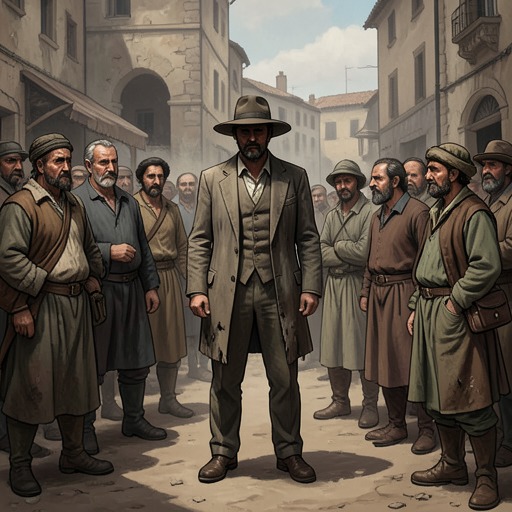
The narrative then brings Akis into view on Platia Syntagmatos. He sits alone with a glass of tsipouro, watching the people around him. He rolls cigarettes without looking at his hands and smokes without pleasure; the ashtray fills as a waiter periodically brings another drink. These repeated actions make his isolation visible without explaining it away. He is not simply passing time in the square: the scene establishes a routine that has become a frame for his memory.
Every Saturday, from four until six, Akis occupies the café for exactly two hours. The regularity is strict enough to give the vigil the character of an appointment, while the day’s slowness suggests how heavily the past weighs on the present. He looks toward the Church of St Spyridon, Nafplio, and the steps leading to it. The familiar view draws him back to the wedding day that began his life of waiting.
The Wedding and Its Repetition
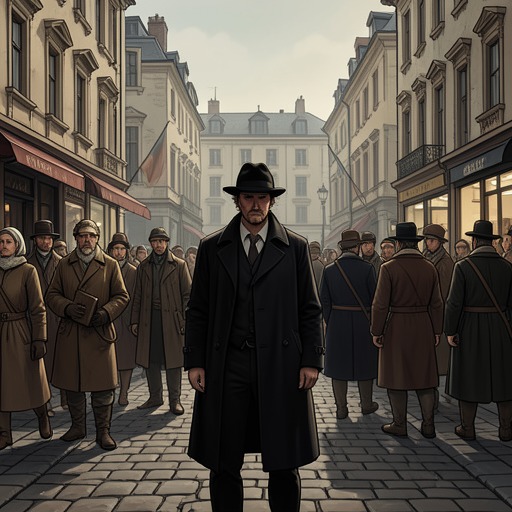
Twenty-five years earlier, Akis arrived outside the church in a shiny grey wedding suit, nervous but prepared to give his bride a bouquet. The ceremony had brought together families and friends: more than three hundred people gathered in the church and narrow street, including relatives who had travelled from the southern Mani and the bride’s kin from Nafplio or nearby. Conversation, laughter, news, and gossip filled the gathering. Even when the priest arrived and the crowd became more reverential, the talk continued.
The guests expected a celebration that would last until the early hours, and nobody was watching the time. Against that crowded beginning, Akis’s later Saturday solitude is especially stark. The story does not present his ritual as an escape from the wedding memory. Instead, he returns to the church and mentally repeats the approach to the ceremony, revisiting the younger self who still expected to hand over the flowers and marry Savina. The square’s ordinary bustle surrounds this private recurrence but does not interrupt it.
Vendetta and the Limits of Revenge
The local account places Akis’s response within the Maniot code of vendetta. When he and Nikos drive out of the village, they stop after several minutes to discuss what is to be done. Akis speaks of the retaliation as uncertain; Nikos treats it as inevitable, insisting that the question is when, not whether. The exchange makes their shared background explicit: both men are from the Mani, and the narrative presents vendetta as a force shaping the decision between them.
Akis keeps a gun in his car for a quarter of a century. When the moment comes, he hears the clock strike five as he crosses the square toward his car; the account marks this as the point at which the long wait ends. According to the couple who tell the narrator what followed, Akis drove back that evening to the village outside Nafplio and killed Savina’s father and brother. He left her mother and sister alive. He was arrested on the day of the murders.
His retaliation does not become a pursuit of Savina. Akis does not track her down, and the narrator understands that her grief and guilt may have been severe; that is the narrator’s inference, not a reported account of her thoughts. The narrator also wonders whether Savina feared that Nikos, identified as the best man, might continue the violence. The distinction between the family members Akis targeted and the bride he did not pursue gives the episode its unresolved shape: the revenge is enacted, but the relationship at its centre remains beyond his reach.
Aftermath and Narrative Significance
The couple’s story reaches the narrator while he is travelling alone and grieving a relationship of his own. Its irony is explicit: they do not know his circumstances, yet describe a man consumed by the loss of a woman who left him. Akis’s story becomes a point of comparison, not because the narrator equates heartbreak with murder, but because the account forces him to consider what loss can do when it is bound up with honour and revenge. He says that sorrow has left him without the energy to lift or fire a gun, and doubts that murder could provide the catharsis he seeks.
The narrator reflects that Akis may have been consumed by the loss of Savina, or by the loss of face, and imagines him still in prison wondering where she is and with whom. The continued imprisonment is presented as speculation rather than confirmed fact. The narrator also notes that some marriages in the area are semi-arranged between families seeking ties, then wonders whether Savina and Akis’s marriage was one of them. Neither the arrangement nor Savina’s reasons for fleeing are established; the account leaves both questions open.
Akis’s weekly vigil gives that uncertainty a concrete form. The exact two-hour visit, the church steps, the repeated smoking, and the remembered wedding suit connect the present-day figure to the man who once expected a crowded celebration. His story is therefore not only a local account of revenge. It is also a counterpoint to the narrator’s own grief: the same experience of abandonment can lead toward very different actions, and the passage offers no simple remedy for either man’s pain.